
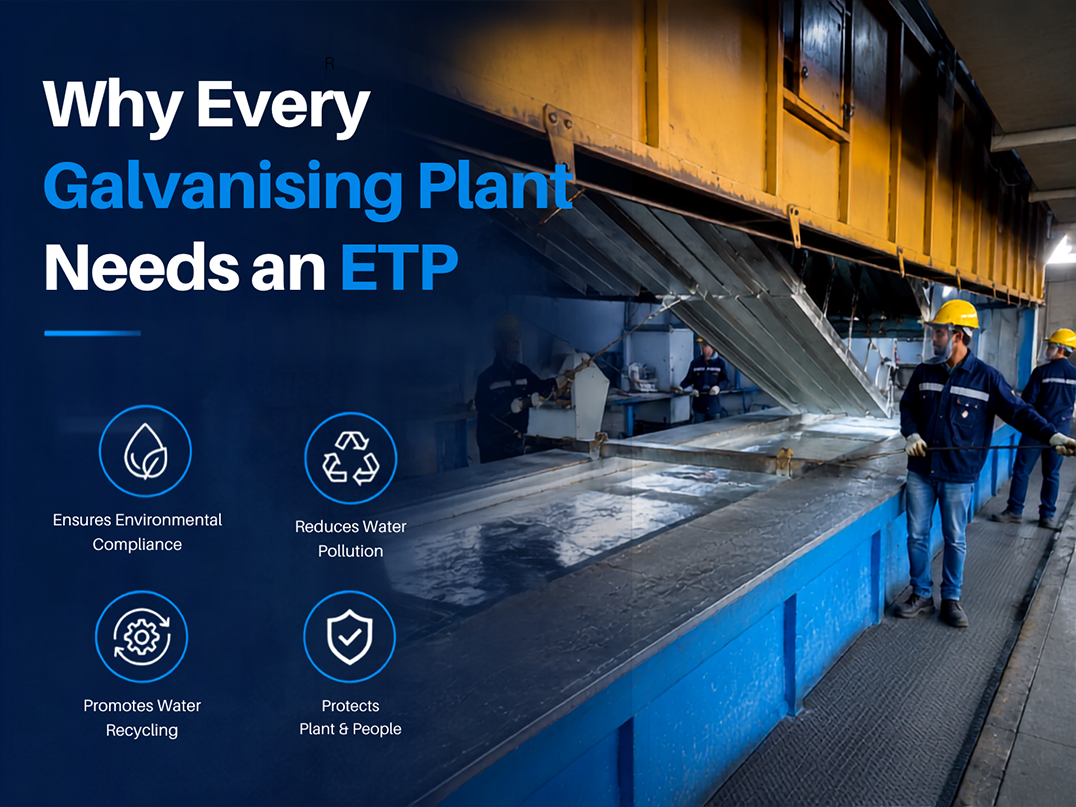
Hot dip galvanising is one of the most effective methods of protecting steel from corrosion. But it also produces wastewater with heavy metals, alkalis, acids and other contaminants. This wastewater can have negative environmental impacts and cause regulatory non-compliance if it is not treated properly. This is why every galvanising facility should invest in a reliable Effluent Treatment Plant (ETP).
For any potential new galvanising plant or existing galvanising plant upgrades, an understanding of the importance of an ETP is a key to sustainable and efficient operations.
Full Form of ETP: ‘Effluent Treatment Plant’.
ETP is a unique process for treating effluents prior to discharge or re-use. An ETP can remove the hazardous substances from the wastewater and make the treated effluent meet with the environmental standards for discharge.
The role of an ETP in the hot dip galvanising industry is very critical when it comes to managing the water that is generated from pickling, rinsing, fluxing and cleaning.
There are multiple chemical processes associated with the hot dip galvanizing, which result in contaminated wastewater. This wastewater may be harmful to water bodies, soil and environment if it remains untreated.
The installation of an Effluent Treatment Plant has several benefits:
An efficient ETP is more than a legal obligation – it's an investment in operational excellence.
An Effluent Treatment Plant follows a systematic treatment process to remove contaminants from industrial wastewater. The typical stages in the design are as follows:
All wastewater from various galvanising processes are collected and stored in an equalisation tank, for a consistent feed into treatment.
The pH of acidic or alkaline wastewater is adjusted using suitable chemicals to achieve safe operating levels.
Coagulants and flocculants are added to separate suspended solids and dissolved heavy metals from the wastewater.
The formed sludge settles in a clarifier, while cleaner water moves to the next treatment stage.
The water passes through filtration units to remove fine particles and remaining impurities.
After treatment, the water can either be reused within the plant or discharged according to environmental regulations.
A very common question when planning a project is how the capacity of an Effluent Treatment Plant is determined?
The amount and properties of the wastewater that the plant produces is the main factor in the Calculation of ETP. When deciding on a pipe fitting, engineers consider a number of factors such as:
A simplified calculation is shown as:
The Total Wastewater Generated Per Day + Safety Margin = ETP Capacity.
But the design of an efficient ETP is not a cookie-cut formula. The pH, Total Dissolved Solids (TDS), Chemical Oxygen Demand (COD), Biological Oxygen Demand (BOD), suspended solids and zinc concentration are carefully analyzed before selecting the treatment process that is best suited.
By calculating the ETP optimally, there are no unnecessary operational costs while getting maximum results.
The installation of an Effluent Treatment Plant demands a lot of technical expertise in galvanising process, wastewater chemistry and environmental compliance. This is where Radadia Engineering comes in handy.
Radadia Engineering has extensive experience in the design of a complete hot dip galvanisation plant and offers individual solutions of ETP, which are formed according to the individual production capacity and the individual operating requirements of the customer.
Their approach includes:
Rather than providing a single "one size fits all" system, Radadia Engineering designs ETP solutions that complement the galvanising process, delivering productivity and environmental sustainability for manufacturers.
Each galvanising factory will have its own set of wastewater properties. Engaging the services of an experienced engineering firm guarantees that the ETP will be well designed and operational, able to cope with increased production in the future.
An effective ETP will save on maintenance expenses, make water management efficient, and help in sustainable manufacturing practices.
Installation of an Effluent Treatment Plant (ETP) has become mandatory for hot-dip galvanising industries. This is because of the need to ensure compliance with environmental regulations, efficient operations, and sustainable development. It is important that you comprehend the ETP full form, working, and calculation of ETP in order to make investment decisions.
If you are planning a new galvanising facility or upgrading your existing wastewater treatment system, Radadia Engineering offers customized ETP solutions designed specifically for hot-dip galvanising plants. Contact our experts today to discuss your project and build an efficient, compliant, and future-ready ETP solution.