
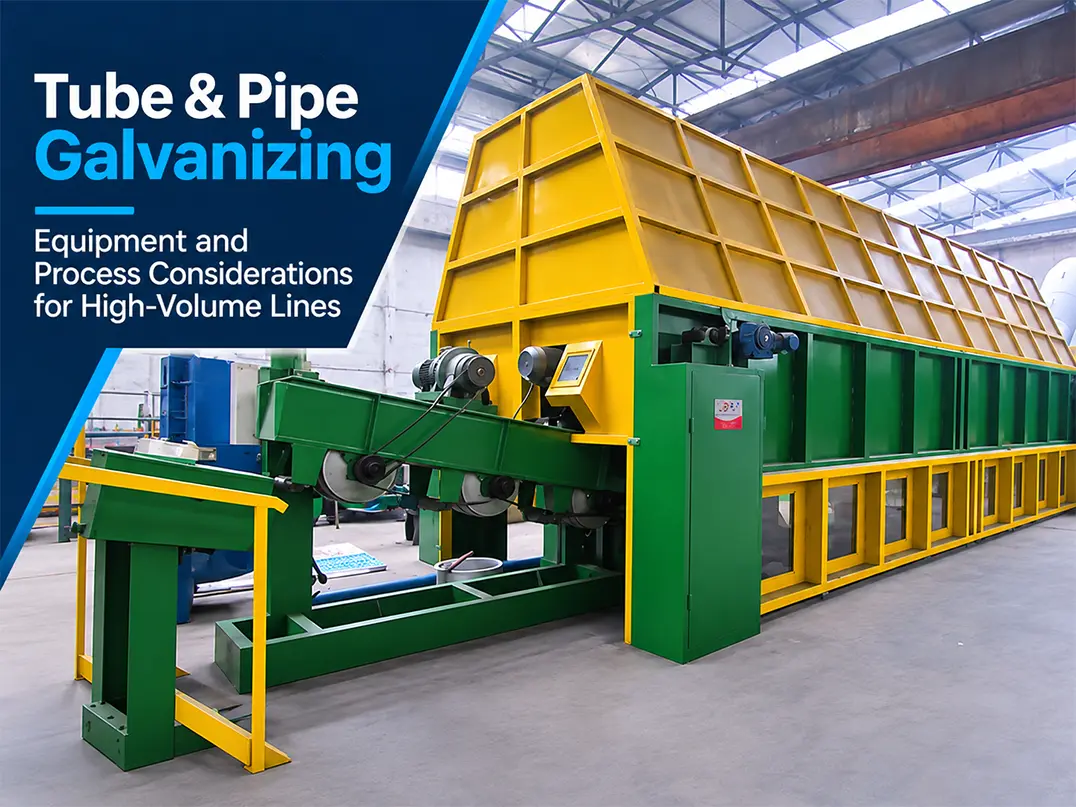
The applications of steel tubes and pipes are very wide spread in infrastructure, construction, water supply distribution and industrial applications. Hot dip galvanizing is often used to protect them from corrosion and prolong their lifespan. When there is a high throughput of tubular products being processed, it becomes important to choose the correct equipment and plan an efficient production line to ensure a consistent product quality and reliable production.
All of these considerations including dimensions of the products, handling of the products, flow of the process, and production targets are vital for the design of a good galvanizing line for tubes and pipes. The knowledge of these aspects will help the manufacturers to make good decisions about their plant.
Hot dip galvanizing is the process of coating steel surfaces with a protective layer of molten zinc. The process is typically degreasing or cleaning, acid pickling, rinsing, fluxing, drying, galvanizing and post-treatment if necessary.
The end quality of the coating is determined by each stage. If there is any downtime or inconsistencies in one stage of the line, it can impact the other stages if it is a high volume operation. A well-designed Tube and pipe galvanizing system allows for a more controlled movement of material from one process step to the next and aids in maintaining uniformity of production.
The equipment configuration should be selected according to the type of pipes being processed, their dimensions, and the expected production volume.
The length, diameter and number of pipes used in each production cycle require the kettle to be a certain length. Its capacity and size will be commensurate with the product line and throughput provided by the manufacturer.
Another crucial factor to consider is the heating system. Stable temperature control is essential to ensure proper galvanizing conditions, and a properly designed furnace can aid in efficient operation. The selection of equipment should include its production requirements and long-term maintenance needs.
It may be hard to move the long and cylindrical products when you manufacture a number of product lines daily. In order to move pipes from one stage of manufacturing process to another, there is a need to use loading stands, hoists, cranes, conveying devices, and appropriate fixtures.
Automatization can reduce manual intervention and provide more repeatable actions needed for high-volume manufacturing. The degree of automatization must correspond to the capacity of a line and to the investment policy.
Surface preparation is critical for good zinc coating bond. The product size and processing order should be considered in the design of pre-treatment tanks and equipment.
When designing the plant, it is also necessary to take into account the fume extraction and other environmental control systems. If these systems can be integrated at the beginning, conflicts in the system layout and expensive adjustments after installation can be avoided.
An efficient layout streamlines pipe flow through cleaning, galvanizing, cooling and finishing processes, minimizing unnecessary handling. When placing equipment, floor space, pipe length, movement paths, operator access and maintenance should be taken into account.
A Tube and pipe galvanizing system designed around the actual product mix can help reduce bottlenecks and improve material flow. Additional production capacity should also be taken into account when designing, since production capacity can be increased later and this may lead to the need to change equipment and infrastructure.
A number of factors affect the quality of the coating, such as the steel's properties, the preparation of the surface, the condition of the zinc bath and the approach of immersion. Operators can use regular equipment maintenance and process monitoring to detect problems in advance, avoiding the risk of problems occurring in large production quantities.
Before configuring the equipment, manufacturers should establish necessary coating requirements and inspection procedures. Process controls, handling procedures, and quality controls can be determined based on these requirements along the line.
Choosing equipment solely on the production rates may result in operational issues if product dimensionality, handling requirements, and processing requirements are not considered. A detailed production range and plant layout analysis, as well as utility, environmental controls and automation requirements, gives a better foundation for equipment selection.
Radadia Engineering specializes in the engineering, manufacturing, plant design and consultancy for hot dip galvanizing programmes. Its history of convincing plant solutions can aid producers assess equipment setups and design plants according to production requirements.
Whether you are looking to install a new line or upgrade an existing facility, contact Radadia Engineering to discuss your needs and see how to fit a Tube and pipe galvanizing system into your production goals.