
Steel is one of the most important materials used in industries such as construction, infrastructure development, power transmission, telecommunications, and manufacturing. Despite its strength and durability, steel is highly vulnerable to corrosion when exposed to moisture, air, and environmental conditions. To protect steel from rust and extend its service life, Hot Dip Galvanizing (HDG) is widely used across many industries.
Hot dip galvanizing provides a reliable and long-lasting protective zinc coating on steel surfaces. It plays a vital role in industries such as transmission towers, telecom towers, solar structures, road crash barriers, and structural fabrication, where steel components must withstand harsh outdoor conditions for many years.
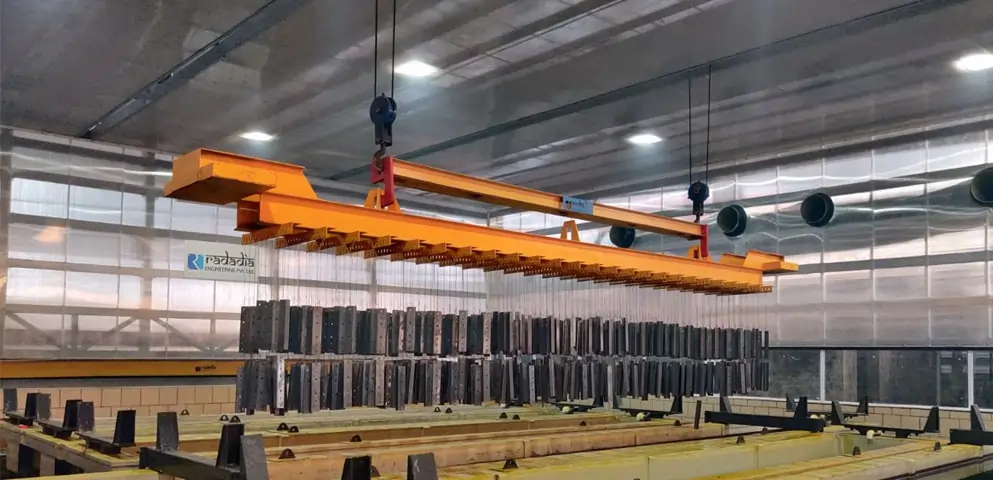
Hot Dip Galvanizing is a corrosion protection process in which steel or iron components are immersed in molten zinc maintained at a temperature of approximately 450°C. During this process, the zinc reacts chemically with the steel surface and forms several layers of zinc-iron alloy.
These alloy layers create a strong metallurgical bond between the zinc coating and the steel surface. The coating acts as a protective barrier that prevents moisture and oxygen from reaching the steel, thereby protecting it from corrosion.
As result, galvanized steel can remain protected for several decades, depending on the surrounding environmental conditions.
The hot dip galvanizing process involves a sequence of controlled steps to ensure proper surface preparation and high-quality zinc coating.
1. Degreasing / Cleaning
The steel components are first cleaned using an alkaline solution to remove oil, grease, dust, and other surface contaminants. Proper cleaning ensures that the zinc coating adheres effectively to the steel surface.
2. Pickling
After cleaning, the steel is immersed in an acid bath, typically hydrochloric acid. This stage removes mill scale, rust, and oxide layers from the steel surface, preparing it for galvanizing.
3. Fluxing
A flux solution, commonly made of zinc ammonium chloride, is applied to the steel components. The purpose of fluxing is to prevent oxidation before galvanizing and to improve the bonding between zinc and steel.
4. Drying
The steel components are dried to remove moisture before they are dipped into molten zinc. Proper drying is essential to avoid defects during the galvanizing stage.
5. Galvanizing
The prepared steel is immersed into a bath of molten zinc maintained at approximately 450°C. At this stage, zinc reacts with the steel surface and forms a strong metallurgical coating consisting of multiple zinc-iron alloy layers.
6. Cooling and Inspection
Once the coating process is complete, the galvanized components are cooled either in water or air. After cooling, they are inspected to ensure proper coating thickness, uniformity, and overall quality.
Hot dip galvanizing offers several advantages compared to other corrosion protection methods such as painting or powder coating.
1. Long-Term Corrosion Protection
The zinc coating provides long-term protection against corrosion, allowing steel structures to last for several decades with minimal maintenance.
2. Complete Surface Coverage
Molten zinc flows easily over the entire steel surface, ensuring full coverage including edges, corners, and internal sections that are difficult to coat using other methods.
3. Strong Metallurgical Bond
The zinc coating forms a metallurgical bond with the steel, making it highly durable and resistant to mechanical damage.
4. Cost-Effective Protection
Although the initial galvanizing cost may be higher than painting, the overall lifecycle cost is much lower because galvanized steel requires very little maintenance.
5. Self-Healing Protection
Zinc offers cathodic protection, which means that even if a small portion of the coating is damaged, the surrounding zinc will continue to protect the exposed steel.
Hot dip galvanizing is widely used in industries where steel structures must operate in demanding environmental conditions.
Some of the most common applications include:
Because of its durability and reliability, hot dip galvanizing is considered one of the most effective corrosion protection techniques for steel structures worldwide.
The performance and efficiency of the galvanizing process largely depend on the design and engineering of the galvanizing plant. A properly designed plant ensures consistent coating quality, improved productivity, and energy efficiency.
A modern hot dip galvanizing plant typically includes:
These elements are essential for achieving high-quality galvanizing results while maintaining operational efficiency and environmental compliance.
Radadia Engineering plays an important role in supporting the global hot dip galvanizing industry by providing complete turnkey hot dip galvanizing plant solutions.
The company offers comprehensive services that cover every stage of galvanizing plant development, from initial planning to final commissioning. Their expertise includes plant design, galvanizing kettle manufacturing, energy-efficient furnace systems, flux filtration technology, zinc fume extraction systems, and advanced material handling equipment.
By delivering fully integrated turnkey galvanizing plants, Radadia Engineering helps industries establish efficient, reliable, and environmentally compliant galvanizing facilities. Their engineering experience and technical knowledge enable clients to set up modern galvanizing plants capable of producing high-quality galvanized steel products for infrastructure, power transmission, telecommunications, and other critical industries.