
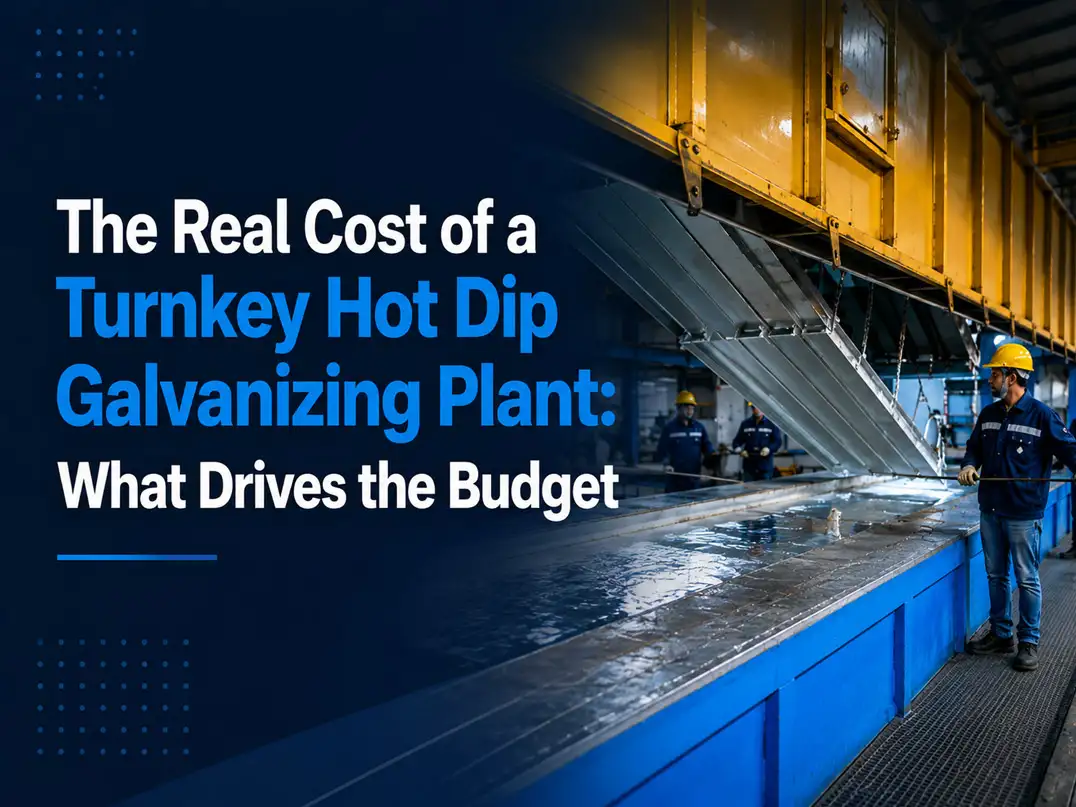
Setting up a turnkey hot dip galvanizing plant is a significant industrial investment. However, the total project cost is rarely determined by the galvanizing kettle or furnace alone. A successful plant involves engineering, civil planning, material handling, pre-treatment, automation, environmental systems, installation, commissioning, and long-term operational considerations.
For new investors evaluating a complete galvanizing plant setup, understanding these cost factors early can make budgeting more realistic and help avoid expensive changes later. Radadia Engineering provides complete engineering, manufacturing, turnkey project management, and consultancy support for hot dip galvanizing plants and equipment.
The budget for a turnkey project is made up of several interconnected components. The exact investment depends on production requirements, plant configuration, automation level, site conditions, and the type and dimensions of steel products being galvanized.
Capacity is one of the first factors influencing the investment. A plant designed for smaller batches will naturally have different equipment requirements from a high-throughput facility handling large structural steel, tubes, pipes, or fabricated components.
Before finalizing equipment, investors should consider:
Choosing equipment based only on today's production requirements may result in limitations as the business grows.
A complete galvanizing plant setup requires more than installing individual machines. The layout needs to support a logical flow from pretreatment through galvanizing, cooling, finishing, and material dispatch.
Efficient plant layouts can reduce unnecessary material movement, improve workflow, optimize space utilization, and support safer operations. Radadia Engineering's plant design approach considers material movement, automated handling, safety zones, environmental systems, and potential future expansion.
Civil work, foundations, electrical systems, utilities, drainage, ventilation, and other site-specific requirements can therefore become important parts of the overall project budget.
The galvanizing kettle and heating system are among the most important investments in a plant. Equipment selection depends on the required production capacity, component dimensions, operating conditions, and desired efficiency.
A modern plant may also include pre-treatment tanks, flux systems, drying equipment, quenching and passivation systems, fume extraction, zinc recovery equipment, and other auxiliary systems. Radadia Engineering's product portfolio includes galvanizing kettles, pulse-fired high-velocity furnaces, drying ovens, pre-treatment areas, fume extraction systems, and flux regeneration systems.
Automation can have a noticeable impact on the initial investment, but it should be viewed alongside its potential operational benefits.
The use of automatic cranes, hoists, conveyor systems, transfer systems, robotic material handling, and PLC/SCADA systems could assist in improving process consistency, reducing manual handling, and increasing efficiency of production operations. Appropriate levels of automation are determined by production volumes, the nature of products, and labour availability.
For some plants, investing more upfront in automation can make sense when evaluated against expected throughput and long-term operating costs.
Environmental systems should not be treated as optional additions to the budget. A properly designed plant may require acid fume extraction, zinc fume control, scrubbers, enclosed pre-treatment areas, effluent treatment, and other environmental and safety measures.
Planning these systems during the design stage is generally more practical than attempting to retrofit them after installation. Radadia Engineering incorporates environmental and safety considerations into its galvanizing plant design and project consultancy services.
The project cost does not necessarily end when equipment reaches the site. Installation, assembly, testing, commissioning, operator training, trial runs, and post-commissioning support can all influence the final investment.
A turnkey approach can simplify project coordination because engineering, equipment supply, installation, commissioning, and related support can be planned as part of one integrated project. Radadia Engineering offers services covering installation, commissioning, training, maintenance, plant upgrading, and post-commissioning support.
Instead of asking only, “What is the price of a galvanizing plant?”, investors should develop a project-specific cost model. Start with production capacity, product dimensions, plant layout, automation requirements, utilities, environmental controls, civil infrastructure, and future expansion plans.
A detailed feasibility study and project report can help identify major capital requirements before equipment procurement begins. This approach can reduce surprises and create a clearer picture of expected investment and operating requirements.
The real cost of a turnkey hot dip galvanizing plant involves many other factors beyond the price of each piece of equipment. Plant capacity, design, technology, automation, environmental control systems, utilities, installation, and operation are all factors that determine the total cost.
When businesses look at setting up their own galvanizing plants from scratch, it is more logical to consider the whole project as a system instead of comparing prices of individual pieces of equipment.
Looking for galvanizing plant turnkey solution?
Connect with Radadia Engineering to discuss your project requirements and develop a practical, project-specific approach to your turnkey galvanizing plant setup.