
A Strip Galvanizing Plant is used to coat steel strips or coils with a protective zinc layer through a continuous hot-dip galvanizing process. In this system, a long steel strip moves continuously through different processing stages such as cleaning, annealing, and then passes through a molten zinc bath (zinc pot) to form a corrosion-resistant coating. After galvanizing, the strip is cooled, treated, and recoiled for further industrial use.
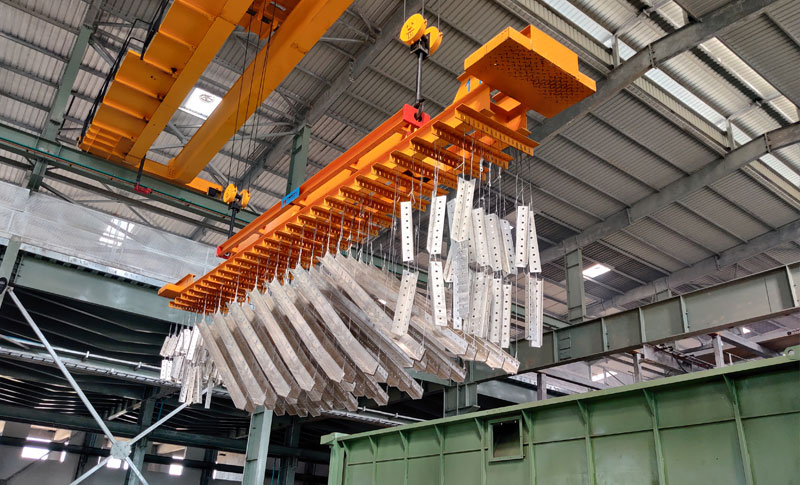
The zinc bath (often called a zinc pot) in strip galvanizing plants is designed based on strip width, production speed, and plant capacity.
Typical Zinc Pot / Kettle Size:
| Plant Capacity | Typical Kettle Size |
|---|---|
| Small strip galvanizing plant | 4 m × 1 m × 1 m |
| Medium strip galvanizing plant | 6–8 m × 1.5 m × 1.5 m |
| Large strip galvanizing plant | 10–13 m × 2 m × 2–3 m |
Industrial strip galvanizing lines commonly use kettles ranging approximately 4–13 meters in length, 1–2.5 meters in width, and 1–3 meters in height, depending on strip dimensions and production requirements.
Typical strip galvanizing plants handle steel strips with the following specifications:
1. Continuous Production Line Design
Strip galvanizing plants operate in continuous processing lines, unlike batch galvanizing plants.
Key equipment includes:
A continuous layout ensures high production speed and uniform coating.
2. Zinc Bath Temperature Control
The molten zinc bath must be maintained at stable temperature.
Typical operating range:
Proper temperature control ensures correct zinc adhesion and coating thickness.
3. Strip Speed and Tension Control
Continuous galvanizing lines run at very high speeds.
Typical line speed:
Precise tension control is necessary to prevent strip distortion.