
A Road Crash Barriers Galvanizing Plant is used to apply a corrosion-resistant zinc coating to highway safety components such as W-beam guardrails, thrie-beam barriers, posts, spacer channels, and fasteners using the hot-dip galvanizing process. In this process, fabricated steel barrier components are cleaned and immersed in molten zinc so that a metallurgical bond forms on the surface, protecting the steel from rust and environmental damage for many years.
Road crash barriers are widely used on highways, bridges, expressways, and road medians to reduce the impact of vehicle collisions and improve road safety. Typical W-beam crash barrier sections have an overall length of about 4.3 m with thickness around 2.5–3 mm, which influences the required galvanizing plant capacity.
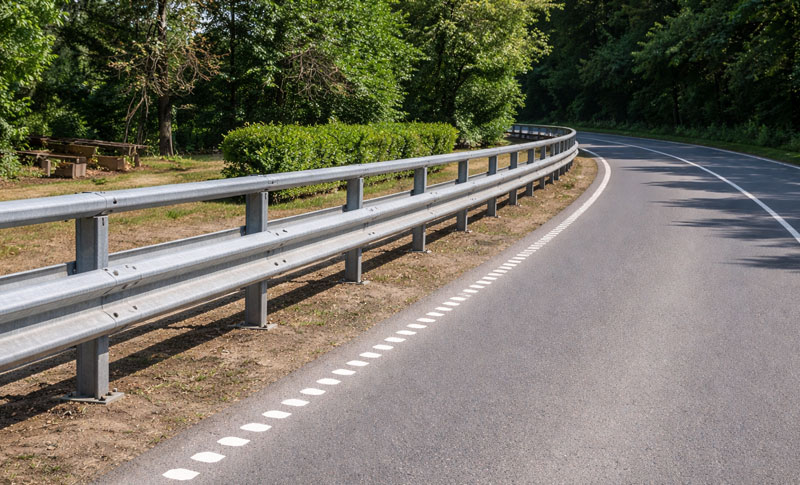
Crash barrier components are long but relatively lightweight structures, so the galvanizing kettle must be large enough to accommodate 4–6 m long guardrail sections.
Typical Kettle Size for Crash Barrier Galvanizing
| Plant Capacity | Typical Kettle Size |
|---|---|
| Small crash barrier galvanizing plant | 6 m × 1.2 m × 1.5 m |
| Medium capacity plant | 8–10 m × 1.5 m × 2.0 m |
| Large crash barrier galvanizing plant | 10–12 m × 2.0 m × 2.5 m |
In the hot-dip galvanizing industry, many facilities operate kettles around 12 m length, 2.4 m depth, and 1.8 m width, which allows galvanizing large fabricated steel structures efficiently.
Some crash barrier galvanizing facilities use kettles around 5 m × 1.2 m × 1.8 m for smaller components and medium-scale production plants.
Road crash barrier galvanizing plants must handle components such as:
These components are normally galvanized with minimum zinc coating around 550 g/m² for corrosion protection according to highway specifications.
I. Maximum Component Length
Crash barrier sections are typically 4–4.5 m long, so the galvanizing kettle must be slightly longer to allow proper dipping and movement.
Recommended kettle length:
II. Production Capacity Planning
Crash barrier plants usually produce large quantities for highway projects.
Typical production capacity:
Production depends on: